Are Leonardo da Vinci’s Bones Actually in His Tomb?
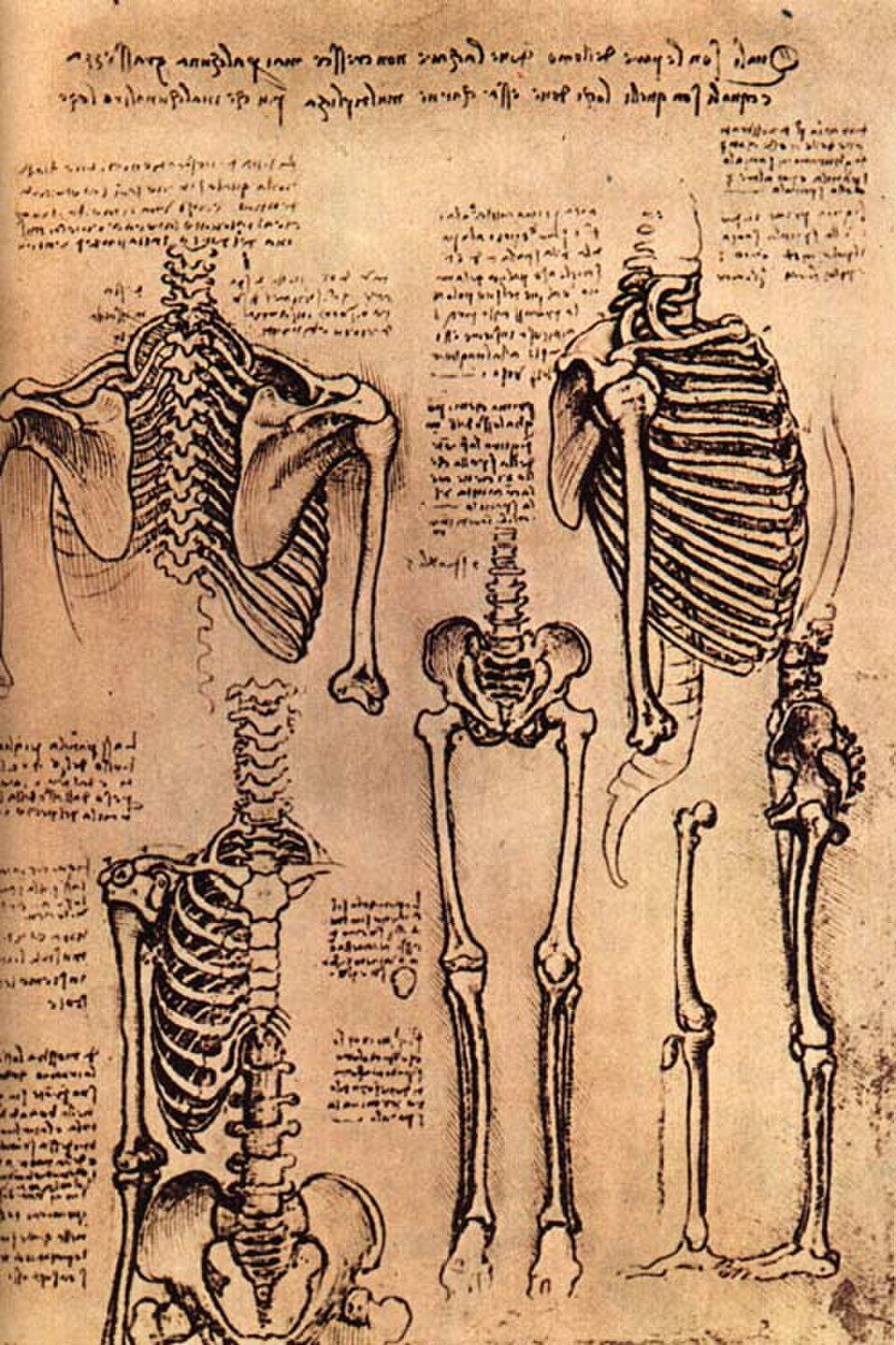
Image: Leonardo da VInci, Public Domain, via Wikimedia Commons
Visitors to the Château d’Amboise in France can walk into the small Chapel of Saint-Hubert and find a tomb bearing one of the most famous names in history: LEONARDO DA VINCI. There is just one problem. We do not actually know whether Leonardo da Vinci is buried there.
The plaque at the chapel is more careful than the tomb itself. It identifies the bones as Leonardo’s “presumed remains.” That uncertainty goes back to the strange circumstances in which the bones were discovered more than three centuries after Leonardo’s death (King, 2016).
Leonardo’s Lost Grave
Leonardo died at Amboise on May 2, 1519, at the age of sixty-seven. He was buried in the royal collegiate church of Saint-Florentin at the Château d’Amboise (King, 2016). His grave did not remain undisturbed. Religious conflict in France and, later, the French Revolution damaged the site. Then, in 1808, Saint-Florentin was demolished. Tombstones were sold, lead from coffins was melted down, and human remains were scattered. According to an account discussed by King (2016), local children even played games of boules with skulls and bones. A gardener named Goujon reportedly gathered some of the scattered remains and reburied them beneath the area where the church choir had once stood (King, 2016). By then, the precise location of Leonardo’s grave had been lost.
The Search for Leonardo
In 1863, French writer, art critic, and government museum official Arsène Houssaye arrived at Amboise with a mission: find Leonardo da Vinci (King, 2016).
The search was not exactly modern archaeology.
As King (2016) recounts, Houssaye relied partly on local memories and stories. One elderly man remembered walking across Leonardo’s tombstone as a child. Goujon’s daughter pointed investigators toward a cherry tree whose abundant fruit, she claimed, was nourished by the human remains beneath it. Another elderly resident directed Houssaye toward a grave marked for a man named Léonard, only for investigators to discover that this particular Léonard had been a local painter rather than Leonardo da Vinci. Then Houssaye’s team found something much more promising.
A Skull Fit for a Genius?
On August 20, 1863, workers uncovered a skeleton near the location of the former church choir (King, 2016). Houssaye became fascinated by its skull. Without the DNA analysis, forensic reconstruction, and other scientific tools available to researchers today, Houssaye relied heavily on physical appearance and his own expectations about what the skull of a genius ought to look like. He admired its broad forehead and believed its shape suited a man of Leonardo’s extraordinary intellect. He also compared the skull with a portrait believed to depict the artist (King, 2016). Doctors who examined the remains estimated that the man had been about five feet five inches tall and was elderly, findings that were broadly compatible with what Houssaye expected of Leonardo (King, 2016).
Other discoveries seemed to strengthen the case. According to King (2016), the gravesite produced Italian coins, a silver object apparently depicting Leonardo’s French patron François I, sandals, and strands of grayish-blond hair. Nearby, investigators also discovered pieces of stone carrying fragments of inscriptions including “LEO,” “INC,” and “EO DUS VINC.” Together, the fragments appeared capable of forming Leonardo da Vinci’s name.
For Houssaye, the mystery was solved. For everyone else, it wasn’t quite so simple.
The Evidence Starts to Crumble
Questions about Houssaye’s methods appeared within years of the excavation.
King (2016) notes that Leonardo scholar Gustavo Uzielli criticized both the archaeological methods and Houssaye’s imaginative interpretation of the skull. By 1906, a French newspaper was still reporting doubts about whether the remains had been correctly identified.
There were other problems. Some of the objects found during the excavation disappeared. The Italian coins, for example, vanished the very evening they were brought into the château, and Houssaye did not record what ultimately happened to the sandals or strands of hair (King, 2016).
Even the physical evidence raises questions. The skeleton reportedly had only eight teeth. Yet a portrait of Leonardo attributed to his pupil and close companion Francesco Melzi, which King (2016) describes as the only depiction unanimously accepted as a portrait likeness, appears to show Leonardo retaining most or all of his teeth late in life. That does not prove the skeleton belongs to someone else, but it gives researchers another reason for caution.
Could Science Solve the Mystery?
Possibly.
King (2016) argues that scientific examination of the remains could potentially provide evidence either supporting or undermining their identification as Leonardo. Leonardo spent decades working with materials that could leave chemical traces in his body. His artistic and experimental work exposed him to substances including lead, arsenic, mercury, and compounds containing aluminum, zinc, and manganese. If the bones are genuinely his, King suggests that unusually high concentrations of some of these substances might be expected (King, 2016).
Leonardo’s extensive use of lead white is particularly intriguing. King (2016) notes that he used large quantities of the pigment, including while working on The Last Supper and the unfinished Battle of Anghiari. Despite that exposure, there is no evidence that Leonardo suffered from lead poisoning.
Leonardo also worked with arsenic, mercury, orpiment, and other potentially toxic materials. His notebooks contain recipes and instructions involving several of these substances, giving researchers another possible line of evidence if the remains were scientifically examined (King, 2016).
But even scientific testing would have to be compared with a historical record that is itself incomplete.
And that is part of what makes the mystery so fascinating.
The Man, the Bones, and the Myth
Leonardo da Vinci may be one of the most famous people who ever lived, but fame has not necessarily made him easier to know. Quite the opposite. As King (2016) emphasizes, documentary evidence about Leonardo’s life and appearance is often surprisingly limited. Later stories and uncertain identifications have repeatedly filled the spaces left by the historical record.
Even the familiar red-chalk image commonly presented as an elderly Leonardo is not securely established as a self-portrait. Its date, authorship, provenance, and identification have all been questioned by scholars (King, 2016).
The story of his bones follows much the same pattern. A nineteenth-century investigator went looking for Leonardo. He found a skeleton near the location where Leonardo had once been buried, discovered intriguing objects and inscription fragments nearby, and became convinced that he had found the Renaissance master. Perhaps he did.
But more than 160 years later, the wording at Amboise remains appropriately cautious.
Inside the Chapel of Saint-Hubert lie not the confirmed remains of Leonardo da Vinci, but his “presumed remains” (King, 2016). Sometimes the most accurate answer history can give us is not yes or no. It is we don’t know.
Further Reading
King, R. (2016). Leonardo’s bones: Myth, history, and evidence. Human Evolution, 31(3), 133–147. https://doi.org/10.14673/HE201631018


Comments